


As I wrote last week, I have been spending a lot of time in the forest. Thank God, the fire department finally came and chipped up the mountain of deadfall I had shlepped out to the roadside, because I had said to myself that once they came and went, then I would stop collecting branches. Job done!
As I did my collecting, I invoked the middah of חריצות (diligence) and our woods are now much more park-like than ever. It’s comical to see our little dachshund, Dr. Pepper, zooming around on the new trails that he has discovered in the woods.
But I’m now done with that task – for this year.
Still, walks in the forest are a major source of refreshment and exercise on this island. The size of the trees reflects our climatic zone, which is designated as Pacific temperate rain forest. Although the island has been logged at least twice, pockets of majestic old trees remain, and even in the logged areas, such as our own property, the trees grow so fast (1’ or more per year) that in the 30 years we have been on the island, we have seen the shrimpy trees around us grow into much more mature giant firs, cedars, balsams, hemlocks and the occasional spruce.
The climate as currently configured is ideal for trees to flourish: plenty of moisture, adequate sunshine, soil, and a year-round growing season. And they grow straight, true and tall. Douglas fir can grow to a height of 100 m. (330 feet). That’s the length of a football field (not counting the endzones).
Walking among the huge trees in the forest yesterday, we came upon a little cluster of Ghost Pipes, also calledIndian Pipe or, more descriptively “Corpse Plant,” because its flower is a sickly white. Its colour reflects the fact that this little plant completely lacks chlorophyll and gets its nutrients through a complex underground connection with tree roots and fungi. If you look it up on the internet, you will see that it is considered rare, though “it commonly grows on Hornby Island and throughout the surrounding Pacific Northwest coast.”
A Ghost Pipe typically stands from 10 to 20 cm (4 to 8 inches), quite a contrast from the surrounding trees.
Which gives me pause to think. A flourishing Douglas fir stands 100 m. tall; a flourishing Ghost Pipe .5 of a metre. There is a lesson for us in the contrast.
The word for “flourishing” or “thriving” in Hebrew isפורח (poreach), a word that shares its linguistic root with the word פרח (perach), a flower. There is a sense that thriving is a kind of blossoming, and what that tells us is that flourishing is not something an entity takes on or acquires; it is a bringing forth into full flower the potentialities that are already seeded within the living being.
Humans also have the potential to flourish, and we do that by a process akin to blossoming. I love that notion because it directs our attention inward rather than outward, and it invites us to measure ourselves not so much by what others have accomplished but by the seeds of possibility that are present within us.
It also tells us that the measure of flourishing is not necessarily size or grandeur. The little Ghost Pipe puts out a delicate, translucent flower that is, by some measure, as magnificent a creation as is the mighty fir.
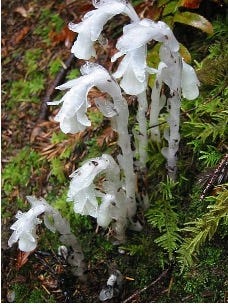
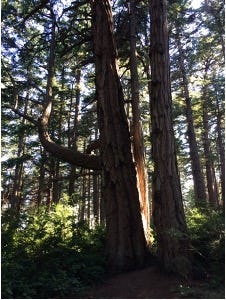
The Douglas fir is primed to grow enormously tall and fulfills its potential way up in the forest canopy. Down below, the Ghost Pipe has the potential to reach its full capacity at a very different order of magnitude. Both thrive on their own terms, not on the terms of the other.
This message converts to the human realm in the recognition that we are all unique individuals and so the seeds of possibility that have the potential to blossom in you will be different from my own potential. We flourish by recognizing what is true for each of us in our own lives and then doing what it takes to water those seeds to grow to their full potential.
Rav Naftali Amsterdam (1832–1916) once said to his rebbe, Rabbi Yisroel Salanter: “Rebbe, if only I had the mind of the Sha’agas Aryeh,1 the heart of the Yesod Veshoresh Ha’avodah2 and your middot (character traits), then I could be a true servant of God. Rav Yisroel responded, “Naftali, Naftali! With your head, with yourheart, and with your character traits, Naftali Amsterdam can be a true servant of God.”
I am very interested in the notion of human flourishing, so, tell me: What gives you the feeling you are thriving?
Alan
1 Rabbi Aryeh Leib ben Asher Ginzberg (c. 1695 – 1785), known by the title of his most famous book, Shaagas Aryeh (“Roar of a lion”), a collection of rabbinic responsa first published in 1755.
2 “Foundation and Root of Service” by Rabbi Alexander Ziskind of Grodno (1735-1794) contains directions for the right use and comprehension of ritual, daily Jewish prayers, Shabbat and holidays.
What was hard about the small things question, James?
The seeds of possibility...having just completed 75 years of living I am wondering if those seeds have now grown. Are there still seeds or is the work to nourish that which has grown within, with an eye towards nurturing balance and recognition of middot as they arise?